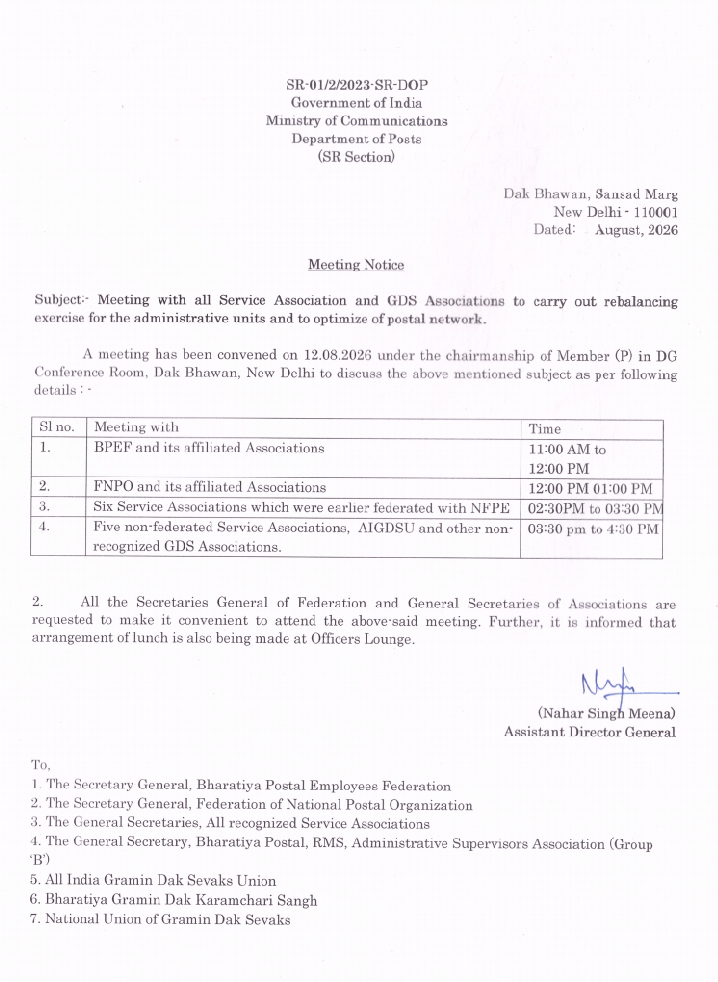
08/08/2026
Birthday GreetingsHearty Birthday Greetings on the 114th Birth Anniversary of our beloved Shri K. Ramamurthy (K.R.)
On behalf of the Federation of National Postal Organisations (FNPO) and on my own behalf, I pay my respectful tributes to the legendary Shri K. Ramamurthy, a visionary leader and torchbearer of democratic and independent trade unionism.
His guiding principles — “Forward Ever, Backward Never,” “Dialogue before agitation – no compromise on welfare,” and “Each Member Catch a Member” — continue to inspire every generation of FNPO members.
Let us rededicate ourselves to his ideals of unity, democracy, transparency and unwavering commitment to the welfare of postal employees, and work together to strengthen FNPO further.
Long Live the Ideals of K.R.!
Long Live FNPO!
Sivaji Vasireddy Secretary General, FNPO
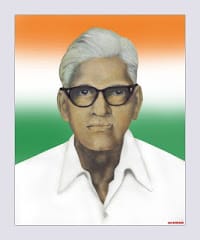 K.R. – The Ocean of the Postal Trade Union Movement
Remembering a Great Leader on His 114th Birth Anniversary
Today, on the 114th birth anniversary of our beloved K.R., let us remember a few drops from the vast ocean of his life, struggles and sacrifices in the Postal Trade Union Movement.
K.R. was not merely a trade union leader. He was an institution. He was a school of trade unionism. He was an ocean of knowledge, courage and experience.
In 1954, the Government of India introduced the Realignment Scheme, under which an attempt was made to bring the different unions in the P&T Department under one organisation.
At that time, K.R. was the Secretary General of U.P.T.W. He could have simply opposed the Government's proposal. Instead, with extraordinary vision, he welcomed the idea of bringing the unions together. He consulted and brought together different groups and played a historic role in forming the NFPTE (National Federation of Posts & Telegraphs Employees) in 1954.
K.R. was one of the principal architects of NFPTE.
But history was not always kind to him. Despite his contribution, he was defeated in the subsequent election for Secretary General. A lesser person might have been broken by such a setback.
K.R. was not.
He returned to Chennai, joined as a Postal Assistant at Triplicane Post Office and once again came back to the forefront of the trade union movement.
He was elected P3 General Secretary and played a leading role in the historic 1960 strike. He was arrested and subsequently suspended for 18 months.
During those difficult days, K.R. made a remarkable pledge:
“I will be the last person to join duty. I will join only after all the suspended striking employees have returned to duty.”
And he kept his word.
This was K.R.—a leader who did not ask others to make sacrifices which he himself was unwilling to make.
After the strike, K.R. fought the legal battle against the derecognition of AIPEU and succeeded in securing its recognition.
At the next AIC, K.R. was not elected as a delegate from Central Division, Madras. He was, however, elected as a delegate from Karnataka. K.R. and nearly 200 other delegates were not permitted to attend the AIC.
Such incidents could have made him bitter. But K.R. continued his journey without surrendering his principles.
From 1962 to 1968, he did not create a separate organisation. He continued to believe that the unity of employees was more important than his personal position.
In 1968, when NFPTE decided to organise a one-day strike, K.R. suggested that the demands should be modified. His suggestion was not accepted, and differences emerged within the movement.
After the strike, the Government relaxed the rules governing the formation of unions in the P&T Department.
On 10 October 1968, K.R. formed National Unions in the P&T Department.
In 1969, FNPTO (Federation of National Postal and Telegraph Organisatons )was formed, marking another important chapter in his trade union journey.
In 1974, K.R. supported the historic Railway strike. He organised the Black Badge Campaign and Lunch-Hour Gate Meetings in support of the struggle.
For this, the Government derecognised FNPTO.
But K.R. did not retreat.
He proved that a real trade union leader must stand with employees during difficult times. Though he followed socialist principles, his trade union movement was never a vehicle for personal political ambition. His first loyalty was always to the employees and their rights.
In 1987, K.R. convened the PJCA and played a major role in organising a strike. The then Minister of Communications called a meeting, and an excellent agreement was subsequently reached between the three Federations and the Government.
As a result, nearly three lakh GDS employees benefited financially.
That achievement alone tells us the magnitude of his contribution.
Due to health reasons, K.R. eventually stepped down from the posts of Secretary General and General Secretary of P3 & GDS. He permanently settled in Chennai.
From 1990 to 1995, he underwent treatment at Government General Hospital, Chennai. I was fortunate to meet him almost every day during those years.
Those meetings were not ordinary meetings for me.
Every conversation with K.R. was a lesson.
Every memory was a piece of trade union history.
Every word carried decades of experience.
I was privileged to listen to him and learn from him.
K.R. was truly a living encyclopedia of the Postal Trade Union Movement.
On 5 October, K.R. left us physically.
But can a person like K.R. really leave us?
No.
He lives in the history of the Postal Trade Union Movement.
He lives in the rights won by employees.
He lives in the organisations he helped build.
He lives in the memories of those who worked with him.
And he lives in every trade unionist who believes that justice is more important than position, sacrifice is more important than comfort, and principles are more important than personal gain.
K.R. is our Pride.
K.R. is our Icon.
K.R. is a guiding light for FNPO.
On his 114th birth anniversary, let us not remember K.R. merely by placing a garland before his photograph.
The greatest tribute to K.R. is to preserve his ideals.
Let us teach the younger generation about his struggles.
Let us tell them how a leader stood alone but never surrendered.
Let us tell them how he accepted defeat but never accepted injustice.
Let us tell them how he faced suspension, arrest and derecognition but continued to fight for employees.
Let us tell them that trade union leadership is not about a chair or a designation—it is about sacrifice, courage, commitment and service.
K.R. gave his life to that principle.
His voice may have become silent, but his message remains alive.
His footsteps may no longer be seen, but the path he created remains before us.
We will remember him not only today, but throughout our lives.
We will preserve his name.
We will carry forward his ideals.
We will pass his legacy to the next generation.
Until our last breath, we shall remember the great contribution of K.R. to the Postal Trade Union Movement.
K.R. Amar Rahe!
K.R. Zindabad!
With respectful and emotional remembrance,
D. Theagarajan
FNPO.