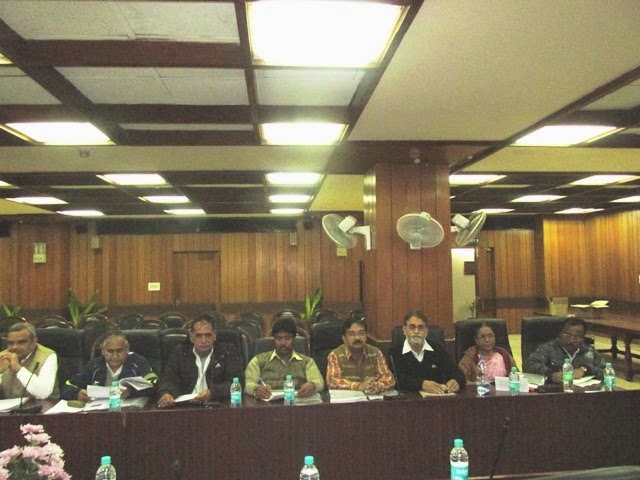
As per the decision of the JCM National
Council Staff Side, a massive National convention of all Central Government
Employees including Railways, Defence and Confederation was held at MPCU Shah
Auditorium, New Delhi on 11.12.2014. About 800 delegates from various parts of
the country participated. Convention was presided by Com. Rakhal Das Gupta
(AIRF) Shri Guman Singh (NFIR) Com. S. N. Pathak (AIDEF) Shri Ashik Singh
(INDWF) Com. K. K. N. Kutty (Confederation), Com. GiriraJ Singh (NFPE) and Shri
Devendera Kumar (FNPO). Com. M. Raghavaiah, Leader, JCM NC Staff Side &
General Secretary, NFIR delivered his opening address. Com. Shiv Gopal Mishra,
Secretary, JCM NC Staff Side & General Secretary, AIRF presented the draft
declaration and also addressed the delegates. In addition to the leaders
mentioned above Com. S. K. Vyas (Advisor, Confederation) Com. C. Sree Kumar
(Secretary General , AIDEF) Shri. R. Srinivasan (Secretary General, INDWF) Com.
M. Krishnan (Secretary General, Confederation), Com. R. N. Parashar (Secretary
General, NFPE) also addressed the convention. Com. K. K. N. Kutty, president,
Confederation summed up the deliberations. The declaration presented was
adopted unanimously with certain modifications. The charter of demands and
programme of action was also approved by the convention unanimously.
NATIONAL JOINT COUNCIL OF ACTION.
OF
CENTRAL GOVERNMENT EMPLOYEES ORGANISATIONS
PARICIPATING IN JCM.
P R E S S S T A T E M E N T.
4.State
Entry Road,
New Delhi.
110 001.
Dated: 11th
December, 2014.
CENTRAL GOVERNMENT EMPLOYEES INCLUDING
RAILWAY AND DEFENCE WORKERS
DECIDES
TO ORGANISE INDEFINITE STRIKE
A National
Convention of Central Government Employees Organisations participating in the
Joint Consultative Machinery was held at New Delhi today (11.12.2014) at MPCU Shah
Auditorium, Civil Lines, New Delhi to deliberate upon the demands and problems of
Central Government Employees remained unsettled for several years. The Joint Consultative
Machinery conceived as a forum for negotiation of demands of Central
Government Employees
in the wake of the indefinite strike action of 1960s has almost become defunct
as its National Council which was to meet thrice in a year has not met even
once for the last four years. The wage revision which was due in 2011 has not come
about even though 7 CPC was set up a few months back. The demand for Interim Relief,
merger of DA with Pay which normally accompanies the announcement of the pay
commission were not granted by the government, the demand for inclusion of Gramin
Dak Sevaks within the purview of 7th CPC was also rejected. Immediately on assumption
of power, the new government has declared a total ban on recruitment, 100 % FDI
in Railways and its privatisation, increasing FDI to 49% in Defence sector, closure
of the Printing Presses, Publication, Stationery and forms offices and Medical Store
Depots, corporatisation of Postal Services, amended the labour laws against the
interest of workers and many other anti-worker policies. The Convention has
adopted a declaration (copy enclosed) and decided upon various programmes of
action culminating in indefinite strike if settlement is not brought about on
the 10 point charter of demands adopted by the Convention. More than 800
delegates representing the two Federations in Railways (AIRF and NFIR), two
Federations in Defence (AIDEF and INDWF), two Federations in Postal Services
(NFPE and FNPO), Confederation of Central Govt Employees & Workers and many
other organisations participated in the
Convention. The
indefinite strike decision and various other action programmes were approved by
the Convention unanimously. The Convention set up a 14 member National Joint
Council of Action with Shri M. Raghavaiah, General Secretary, National Federation
of Indian Railwaymen as its Chairman and Shri. Shivgopal Mishra, General Secretary,
All India Railwaymen Federation as Convener to spearhead the indefinite strike
and other action programmes. The convention was conducted by a Presidium consisting
of S/s Rakhaldas Gupta (AIRF), Guman Singh (NFIR), SN Pathak (AIDEF), KKN Kutty
(Confederation), Giriraj Singh (NFPE) and Ashok Singh (INDWF).
SHIVGOPAL MISHRA
CONVENOR
Enclosure:
Copy of Declaration
NATIONAL CONVENTION OF CENTRAL GOVERNMENT
EMPLOYEES’ ORGANISATIONS PARTICIAPTING IN
JCM
11TH DECEMBER 2014
NEW DELHI
The National
Convention of Central Government Employees organizations participating in the
JCM, being held at New Delhi on 11th December, 2014, adopted the following
declaration after detailed deliberations and discussions.
D E C L A R A T I O N
2. The Central
Government employees have a glorious past of struggles and sacrifices. The
first indefinite strike action in the independent India by employees and
workers of Central Civil Service was in the 1960s. The July 1960 strike was due
to the denial of the legitimate demand of the Central Government employees for
the grant of Minimum wage as per the norms laid down by the 15th ILC. Brutal
repression, unheard in the history of workers struggles, was unleashed by the
then Government of India to suppress the movement. It was in the wake of that
unprecedented strike action, the Government recognised the need to have a
negotiating machinery to look into the grievances of the Central Government
employees and set up the JCM.
3. After the 1968
one day strike and the 1974 tumultuous indefinite strike by the Railwaymen and
others, the organisations participating in the JCM strived their best to create
a conducive and peaceful atmosphere to settle the demands and grievances
through discussions at the JCM. The continuous dialogue in the forum of JCM
helped immensely in avoiding confrontation, struggles and strike actions as the
discussions brought about settlement on issues, thanks no doubt to the positive
role and attitude of the Government in power then.
4. Unlike the
provincial Civil Service, 85% of the Central Government employees are
industrial or operational workers, covered by the Industrial disputes Act.
Peace and tranquillity in workplaces provided for increased production,
productivity and efficiency. The Railways, the defence production units, the postal services and other
industrial establishments and employees of administrative offices played a
vital role in bringing about the significant turnaround in the
employer-employees relationship.
5. However, the
scenario underwent a vast change in the latter part of 1990s. Government
promulgated the new Recognition Rules making it necessary for the Unions to
seek fresh recognition. After the initial hiccups, the employees’ organisations
abided by the Government directive and carried out all stipulations and
conditions required for the grant of recognition. Despite that, the recognition
has eluded some organisations while in the case of many others Government took
years to grant recognition. During this period, the JCM was virtually closed
down at the Departmental levels. The National Council which as per its own
constitution is to meet thrice in a year seldom met in the last four years.
Even when the Standing Committee or the Anomaly Committee met, it was an
exercise in procrastination. The Government unilaterally took various decisions
viz. closure of departments, outsourcing, banning recruitment and creation of
posts, untenable restriction on compassionate appointments; referring the
decisions of the Board of Arbitration to the Parliament for rejection; introduction
of large scale contractorisation and above all withdrawal of the age old
defined benefit pension scheme and introduction of a defined contributory annuity
scheme etc. In the process of this hegemonic approach of the Government, the
common employees lost confidence in fair play and the efficacy of JCM as a
forum to settle their demands. Consequently, litigation is being resorted to by
the common employees with high degree of success. Despite four rounds of
discussion in the National Anomaly Committee, which was set up after the 6th
CPC recommendations were implemented, no settlement could be brought about on
any issue. They found the situation elsewhere not different and aligned
themselves with the common trade union movement of the country in fighting
against the new economic policies.
6. The workers in
general and the Central Government employees in particular were and continue to
be the victims of severe economic offensive of the successive Governments that
came to power in the country since the new economic policies were ushered in
1991. Systematic downsizing and outsourcing of Governmental functions; closure
of Government departments;; privatization of public enterprises, amending
labour laws to facilitate exploitation; lowering interest rate, unbridled
inflation, allowing the foreign and domestic monopoly capital to loot and
plunder the indigenous resources had been some of the visible characteristics
and impacts of the reforms undertaken.
7. The
liberalisation and globalisation policies of the successive Governments, which
came to power since 1991 and which received the backing and support of the
dominant opposition parties and elite in the society accentuated unemployment,
dismantled the Public Sector Undertakings, allowed unhindered entry of foreign
capital, destroyed the livelihood of the farmers and agricultural labourers;
raised the prices of all essential food items beyond the purchasing capacity of
the common people; granted huge tax concessions to corporate houses;; siphoned
off the poor man’s earnings into the hands of a few rich; These measures
ultimately drove the majority of Indians to be below the poverty levels. Indian
youths were driven to be beggars at the doorsteps of transnational corporations
of the developed Nations.
8. At the General
elections for the 16th Lok Sabha, the Indian Common men handed the Indian
National Congress, who led the UPA II regime the worst ever defeat in its
history. Those who came to power over the defeat of the century old party, i.e.
the NDA led by the Bharatiya Janata Party have no different approach on
policies or governance. They had in fact supported the UPA Government to
intensify the neo liberal policies. But for their solid support the PFRDA bill
could never have been passed by the UPA. The conglomeration of Corporate houses
and the corporate controlled media supported the BJP to the hilt in the
election process for they were certain that BJP shall be more pliant and compliant
to them. Through various policy pronouncements the new Government has made its
intentions clear and loud. A complete ban on recruitment in Governmental
organizations has been instituted; privatization of the Railways and Defence is
on the anvil; FDI has been allowed to have its entry into these two vital
sectors, which had been excluded due to public opinion by the UPA; decided to
corporatize the Postal Services; the New pension scheme will replace all
existing defined benefit pension dispensations; decided to close all Government
of India Printing Presses (including the publication, Stationery and forms
stores); handed over the functions of the Medical Depots to private contractor
firms rendering thousands of workers redundant and jobless; withdrawn the
guidelines regulating the prices of essential and life saving medicines;
proposed to reduce the number of subsidized gas cylinders; announced the PPP
model of infrastructure development in Railways; declared further disinvestment
of the profit making PSUs and closure of all loss making enterprises;
introduced legislation to drastically amend the labour laws to harm the interest
of workers especially in small establishments; indicated to give further
concessions to corporate houses on taxation and to increase the indirect taxes
to reduce fiscal deficit; made legislation to increase the FDI in Insurance and
effect further reforms in the Banking Sector; dismantled the Planning Commission
and above all has taken tacit steps to disrupt the secular social fabric of the
country.
9. It is in the
backdrop of this National scenario that the Central Government employees must
look up for settlement of their demands. The Central Government employees had
been active participants in the struggles and strike actions of the Indian
Working Class in the last two decades against the neo liberal policies. They
have marched to the Parliament house shoulder to shoulder with other segments
of the working people on several occasions and more recently on 5th December,
2014 to register and demonstrate the emphatic protest and opposition to the
Government’s economic policies. They will be enthusiastic participants in
future struggles and strike actions chalked out by the united platform of the
Central Trade Unions in the country. While being part of the common struggles
of the working class, they will have to chalk out programmes to ensure that the
Ban on recruitment in Governmental institutions is lifted; the decision to
close down the Printing Presses and the Medical stores is rescinded; growing
contractorisation, privatization and outsourcing of the Governmental functions
are halted; the proposal to allow FDI and privatize the Railways and Defence
Establishments is nipped in the bud itself; the proposed labour reforms are
taken back; that the casual and contract labourers and GDS are paid the minimum
wage; a scheme drawn up for their regularisation within a stipulated time frame
and the social security measures presently available to the workers in the form
of defined benefit pension scheme is retained. 10. They must simultaneously
endeavour to ensure that the JCM functioning is revived; periodicity of its
meeting is increased to conform to the rules; the meeting of the Councils at
the Departmental level are convened; the unions are recognized as per the
rules; the National Anomaly Committee items are taken to its logical end and
the awards of the Board of Arbitration are implemented.
11. Above all, they
must strive immediately that the Government takes a decision on the date of
effect of the Wage revision as 1.1.2014; the ambit of the 7th Central Pay
Commission covers the most exploited segment of civil servants, i.e the Gramin
Dak Sewaks ; that the wage structure of GDS is not allowed to be at the whims
and caprices of Postal bureaucrats; that the Central Government employees are
granted interim relief at the rate of 25% of their pay plus GP; the Dearness
allowance which stood at 100% of pay as on 1.1.2014 is merged to become
Dearness Pay and the 7th CPC adheres to its time frame of 18 months and all the
JCM participating organization are given sufficient opportunity to present
their case before the Commission.
12. The Convention,
on the basis of the discussions amongst the participating organizations,
formulates a charter of demands containing the following important issues. The
Convention also adopts the following programme of action to culminate in an
indefinite strike action if the demands are not negotiated and settled.
13. The Convention
sets up a National Joint Council of action with the representatives of the
participating organizations to spearhead the movement. The JCA will prepare a
detailed pamphlet to explain each of the demands in the Charter and to
circulate the same amongst the mass of the employees for an intensive campaign.
The NJCA at the National level will monitor the implementation of the
programme. The Convention directs the participating Federations/Unions and
Associations to form such Joint Committees in all States to ensure that the
programme of action is carried out in all States uniformly.
14. The Convention
calls upon all Central Governments employees and their Unions and Federations
to be active participants in all the programmes of action to bring about a
satisfactory settlement of the demands.
Charter of demands.
1. Effect wage revision of Central Government employees
from 1.12014 accepting the memorandum of the staff side JCM; ensure 5-year wage
revision in future; grant interim relief and merger of 100% of DA. Ensure
submission of the 7th CPC report with the stipulated time frame of 18 months;
include Grameen Dak Sewaks within the ambit of the 7th CPC. Settle all
anomalies of the 6th CPC.
2. No privatisation, PPP or FDI in Railways and Defence
Establishments and no corporatisation of postal services;
3.
No Ban on recruitment/creation of post.
4.
Scrap PFRDA Act and re-introduce the defined benefit
statutory pension scheme.
5. No outsourcing; contractorisation, privatisation of
governmental functions; withdraw the proposed move to close down the Printing
Presses; the publication, form store and stationery departments and Medical
Stores Depots; regularise the existing daily rated/casual and contract workers
and absorption of trained apprentices;
6.
Revive the JCM functioning at all levels as an effective
negotiating forum for settlement of the demands of the CGEs.
7.
Remove the arbitrary ceiling on compassionate
appointments.
8.
No labour reforms which are inimical to the interest
of the workers.
9.
Remove the Bonus ceiling;
10.
Ensure five promotions in the service career.
PROGRAMME OF ACTION
1. Organise State/District/Divisional level Joint
convention to popularize the declaration before Feburary, 2015.
2. To organize massive dharna/rally at all State
Capital/major Defence centres jointly by all the participating Unions in March,
2015.
3.
To organize campaign fortnight throughout the country
in the first two weeks of April, 2015.
4. To organize Rally before the Parliament house in the
month of April when the house will be in budget session to declare the date for
the commencement of the indefinite strike action and the programme and date of
serving strike notice.
O0o